

What Is AURA and How Does It Improve Automation Runtime Assurance?

When a bot fails in production, the problem rarely starts with the bot itself. It usually starts somewhere else: an exhausted database connection pool, an expired authentication token, a slow API, or an application the automation team does not own. By the time an alert fires, the business is often already feeling the impact, and the alert points to the symptom rather than the source.
According to AutomationCOE, 73% of automation failures originate in systems that automation teams do not own. That raises a question every Automation CoE leader should be asking: how do you protect what you cannot control?
That is the question AURA was built to answer.
What Is AURA?
AURA (Automated Uptime & Runtime Assurance) is AutomationCOE’s AI runtime agent. It continuously monitors bots, applications, APIs, databases, and infrastructure, predicts failures before they affect business operations, and traces incidents to their root cause.
Developed by Tecnoprism, AURA powers the Deploy and Support stages of AutomationCOE’s 5D1S lifecycle. Where most monitoring tools report what has already broken, AURA is designed to show what is about to break and why.
What Is Automation Runtime Assurance?
Automation runtime assurance is the practice of keeping production automations reliable, available, and performing to SLA. It goes beyond basic bot monitoring by validating the readiness of every system an automation depends on, detecting anomalies in real time, and resolving incidents before they disrupt business processes.
Why Do Automations Fail in Production?
Most production failures share a few common causes:
- Dependency failures in applications, services, and infrastructure outside the automation team’s control
- Authentication and token expiry that stops bots mid-run
- Capacity and throttling limits in databases, APIs, and queues
- Data and replica lag that leaves bots working with outdated information
- Symptom-level alerts that identify where a failure surfaced, not where it began
- Reactive support models, where teams learn about failures only after business users report them
As automation estates grow to hundreds of bots, these risks multiply. Without runtime visibility, every new automation adds another set of dependencies that can fail silently.
How Does AURA Work?
AURA acts as the operational nervous system of an automation estate. It connects natively to orchestrators including Automation Anywhere, UiPath, and Microsoft Power Automate, then brings monitoring, health analysis, alerting, and operational intelligence into a single runtime assurance platform. Its core architecture combines a schedule puller, health engine, real-time monitor, alert engine, operations room, and role-based access control layer.
The result is complete visibility across bots, systems, databases, and business applications, from one place.
What Are AURA’s Core Capabilities?
Dependency Intelligence
Every automation depends on systems its team does not control. AURA continuously maps the relationships between bots, applications, services, and infrastructure, so risks are identified before they cascade across multiple automations.
Pre-Execution Readiness Checks
Before a bot runs, AURA checks device health, measures application latency to prevent timeouts, and confirms database storage readiness. Problems are caught before execution rather than in the middle of a business-critical run.
Real-Time Execution Monitoring
Every run is tracked live, and errors surface instantly. Teams no longer wait for a business user to report that something went wrong.
Root Cause Analysis
AURA automatically traces incidents across connected systems and correlates the signals to identify the true source of failure. A cascade of API timeouts and session resets, for example, can be traced back to a single exhausted database connection pool, along with a recommended resolution.
Automated Response
Detection is only the beginning. AURA guides teams through a structured response, from the first signal to verified recovery:
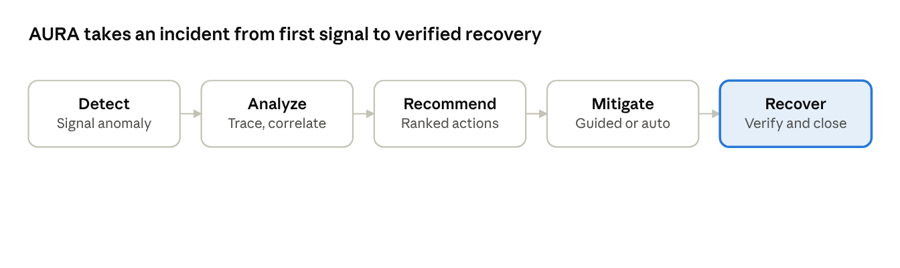
Mitigation can be guided by AURA’s ranked recommendations or handled automatically, depending on the incident and the organization’s policies.
Operations Command Center
A unified operations view shows uptime, incidents, performance, regional health, and SLA attainment across the entire automation estate. Leaders and support teams work from the same source of truth.
How Does AURA Improve Automation Runtime Assurance?
AURA changes runtime operations in four fundamental ways:
- From reactive to predictive: failures are anticipated from dependency signals instead of discovered after the business is affected.
- From symptom to source: root cause analysis points teams to where a failure began, not just where it surfaced.
- From hours to minutes: correlated diagnostics and ranked recommendations shorten the time to resolution.
- From fragmented to unified: one operations view replaces scattered logs, dashboards, and alerts.
For the Automation CoE, this means fewer escalations, more predictable SLAs, and support teams that spend their time preventing incidents rather than chasing them.
Where Does AURA Fit in the Automation Lifecycle?
AutomationCOE organizes automation into the 5D1S lifecycle: Discover, Document, Define, Develop, Deploy, and Support. ARIA, AutomationCOE’s intake agent, covers Discover, Document, and Define, turning process recordings into sign-off-ready requirements. AURA takes over at Deploy and Support, validating environments during controlled rollout and protecting automations once they are live.
Together, the two agents address the two points where enterprise automation most often breaks: ARIA fixes intake, and AURA defends runtime.
What Business Outcomes Can Enterprises Expect?
AutomationCOE reports the following outcomes with AURA in place:
- 70% fewer incidents across the automation estate
- 5x faster root cause analysis
- 70% reduction in mean time to resolution (MTTR)
- 99.5% SLA attainment
In one enterprise IT case study, AURA prevented 412 production incidents in 90 days for a global shared services organization operating across more than 90 entities. For executive leaders, these results translate into protected revenue, lower operational costs, and a lower total cost of ownership for the automation program.
Is AURA Right for Your Automation CoE?
AURA is built for enterprises where automation is business-critical: organizations running large bot estates across multiple applications, regions, and teams, often in regulated industries. If your teams learn about bot failures from business users, spend hours diagnosing incidents, or struggle to meet automation SLAs, AURA addresses those gaps directly.
Frequently Asked Questions
What is AURA?
What is automation runtime assurance?
Which RPA platforms does AURA integrate with?
How does AURA prevent automation failures?
How does AURA perform root cause analysis?


Ready to put these ideas into practice?
See how Automation COE transforms enterprise intelligence into measurable business outcomes.