
Healthcare Automation for
Faster, More Reliable Operations

Automate complex clinical and administrative processes without losing accuracy or control. AutomationCOE combines AI-powered process discovery with runtime assurance through ARIA and AURA, helping healthcare organizations scale automation while protecting sensitive patient data.

The Problem

Why Healthcare Automation Struggles to Scale

Healthcare workflows span multiple systems, teams, and locations. Without standardization and visibility, automation becomes difficult to scale and maintain.

01

EHR and Claims System Fragmentation

Clinical systems, payer portals and revenue cycle platforms don't integrate, so someone bridges every interface by hand. Usually across sites that each configured their EHR differently.

02

Prior Authorization Volume

Authorization requests get assembled from clinical notes against payer-specific criteria, by people. Care is delayed and clinical capacity goes into paperwork.

03

Claims Denial and Appeals Burden

Denials arrive with reason codes that need clinical documentation to contest. High volume, deadline-bound, almost entirely manual.

04

Revenue Cycle Complexity

Eligibility checks, billing, payment posting, reconciliation, and follow-ups involve repetitive processes across multiple systems.

05

Patient Administration Workload

Scheduling, registration, referrals, and follow-ups create significant administrative work that takes time away from patient-focused activities.

06

Multi-Site Operational Variance

The same healthcare process may operate differently across hospitals, clinics, or locations, making standardized automation difficult to scale.

The Solution

Scaling Healthcare Workflows with Intelligent Automation

AutomationCOE helps healthcare organizations streamline repetitive workflows, connect fragmented systems, and maintain visibility across the automation lifecycle.

01

Unified System Integration

Bridge clinical systems, payer portals, and revenue cycle platforms seamlessly. Our automation layer integrates fragmented EHR setups across multiple sites without requiring costly backend overhauls.

02

Intelligent Authorization Routing

Automate the extraction of clinical notes and instantly cross-reference them against payer-specific criteria. Accelerate approval timelines and return valuable capacity back to care providers.

03

Automated Appeals Assembly

Absorb denial triage inside the automation. Instantly decode reason codes and automatically compile the necessary clinical documentation to contest high-volume, deadline-bound cases.

04

Revenue Cycle Automation

Automate repetitive tasks across eligibility, billing, claims processing, payment posting, reconciliation, and account follow-up.

05

AI-Driven Case Assessment

Utilize advanced AI agents to ingest, translate, and structure adverse event narratives across multiple languages. Scale your coding and assessment volume instantly without adding headcount.

06

Standardized Process Governance

Deploy an adaptive automation framework that accommodates local site variances while enforcing estate-wide governance. Ensure standardized bots remain resilient, monitored, and highly functional.

92%

Reduction in documentation time

6,500+

Bots deployed globally

100%

PII safe

INDUSTRY OVERVIEW

Powering Accurate, Reliable Healthcare Operations

Healthcare organizations manage large volumes of clinical and administrative information across disconnected systems. Processes such as prior authorization, claims management, patient administration, and revenue cycle operations still require significant manual effort.

AutomationCOE helps healthcare organizations automate these workflows with greater accuracy, visibility, and control. ARIA accelerates process discovery and documentation while AURA provides runtime monitoring and dependency intelligence to keep critical automations running.

Why AutomationCOE

Built for the Complexity of Healthcare Automation

We connect clinical, payer, revenue cycle, and operational systems through a governed automation framework designed for complex healthcare environments.

ARIA Logo
Stage 1

Discover with ARIA

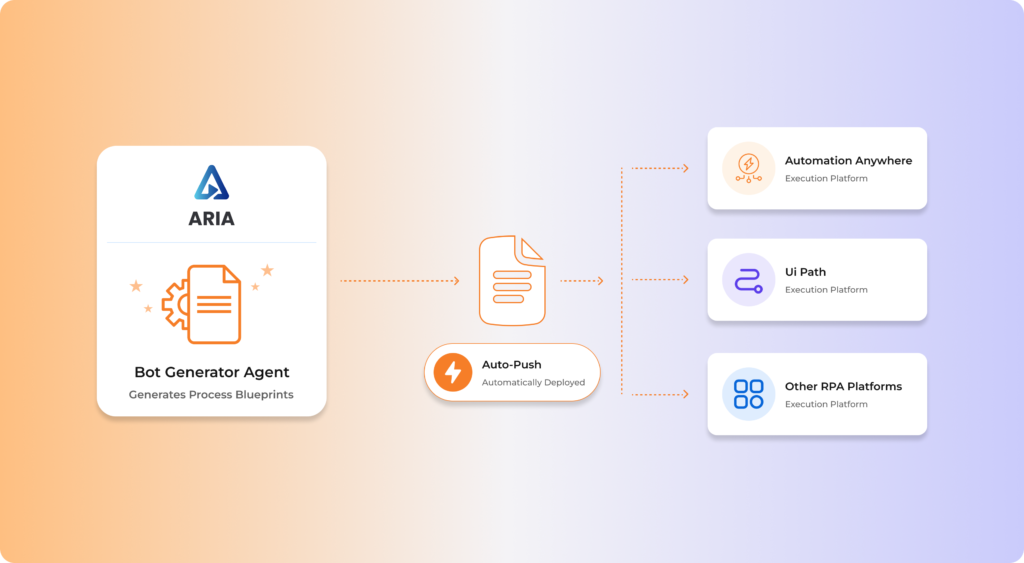
Healthcare automation begins with understanding workflows shaped by clinical, regulatory, and payer requirements, from prior authorization and claims processing to documentation and patient administration. ARIA analyzes process walkthroughs and turns process steps, rules, and exceptions into automation-ready documentation, including BRDs, test cases, feasibility assessments, and effort estimates.This reduces manual documentation and accelerates the journey from discovery to development. ARIA also detects and anonymizes PII by default, helping protect sensitive patient data from the first recording.

Learn about ARIA →
Stage 2

Deliver with 5D1S

5D1S enables healthcare automation to move from discovery to deployment within validated environments. Reusable components work across EHR, payer, clinical, and quality systems, while validation evidence and process traceability are generated as part of delivery, helping teams stay audit-ready from the start.

Explore the framework →

AURA Logo
Stage 3

Sustain with AURA

Healthcare organizations rely on automations where failures can delay authorizations, claims, billing, or other critical operations. AURA provides runtime support and dependency intelligence. It continuously monitors bots and the EHRs, payer portals, APIs, databases, and infrastructure they depend on. It detects issues early, identifies root causes, and gives actionable insights, so critical automations keep running even when clinical systems change without warning.

Learn about AURA →
USE CASES

Healthcare & Pharma use cases

Healthcare

Claims denial triage

Denial reasons read, supporting clinical documentation retrieved, appeals assembled. Only genuinely clinical judgement gets escalated.

Healthcare

Prior authorisation

Authorisation packages built from clinical documentation against payer-specific criteria, then submitted and tracked without anyone reassembling them.

Pharma

Regulated document assembly

Submission and validation documentation generated and cross-checked inside GxP environments, with every source and edit attributable.

Pharma

Adverse event processing

Case narratives processed and coded across languages, with confidence thresholds calibrated to the cost of a missed signal.

SUCCESS STORIES

Proven results in healthcare and life sciences.

Healthcare network, 12 sites

No automation strategy and reactive bot development across 12 sites, an 18% claims denial rate, and no visibility into which automations were contributing to the failures.

ARIA-powered discovery surfaced 280 automation opportunities. The estate was remediated to standard, sequenced into a governed roadmap, and brought under AURA monitoring.

Claims denial rate down to 4.3% within the year.

Read full case study →

Top-5 pharma, validated environment

Clinical documentation assembled by hand under GxP constraints, consuming scientific capacity and carrying PII exposure risk at every handoff.

ARIA-generated documentation with PII detection and anonymisation, delivered inside the validated environment with full change control.

Documentation generated in minutes. Time down 92%, GxP aligned, 100% PII safe, 100% audit pass rate.

Read full case study →

BUSINESS OUTCOMES

Measurable Business Outcomes from Healthcare Automation

Healthcare automation helps organizations reduce repetitive administrative work while improving process visibility and operational efficiency.

92%

Faster Documentation

Clinical and regulatory documentation generated in minutes rather than days, giving capacity back to the people who should be doing the science.

76%

Lower Claims Denial Rate

Denial triage and appeal assembly absorbed inside the automation, with clinical judgment escalated rather than the whole case.

100%

PII Safe

Patient data detected and anonymised at the point of discovery, not remediated later when someone spots it in a process recording.

100%

Audit Pass Rate

Documentation, traceability and change control produced by the process, not assembled for the inspection.

SERVICES

Relevant solutions for Healthcare

INSIGHTS

Related reading

View all insights →

Why Automation programs Stall in the First Six Weeks

How Enterprise AI Is Reshaping Business Decision-Making in 2026

FAQ

Common questions about AutomationCOE.

Not finding your answer? Email us directly.

ARIA helps healthcare teams turn recorded process walkthroughs into structured, automation-ready documentation. It analyzes video, speech, process steps, decisions, and exceptions to generate PDDs, test cases, feasibility assessments, effort estimates, and PII-safe outputs. This can accelerate the discovery phase of healthcare process automation.
ARIA is an Automation Requirements Intelligence Agent designed to accelerate process discovery and automation requirements. For healthcare organizations, ARIA can analyze process recordings, identify workflows and exceptions, generate automation documentation, and detect and anonymize PII before outputs are produced.
Yes. AutomationCOE can automate claims denial triage by reading denial reasons, retrieving supporting clinical documentation, and assembling appeal packages. Cases requiring genuine clinical judgment can then be escalated to the appropriate team, reducing the amount of manual work involved in high-volume denial management.
ARIA includes PII detection and anonymization capabilities designed to identify sensitive information such as names, IDs, and account details. The platform describes its outputs as PII-safe and designed for regulated environments, with redaction verification built into the process.
AURA is designed to trace incidents across connected systems and dependencies to identify the source of failures rather than focusing only on the visible symptom. Its root-cause analysis capability correlates signals across the automation environment to help teams determine where an incident originated.
AURA provides runtime assurance for automation estates by continuously monitoring bots, applications, APIs, systems, and dependencies. For healthcare workflows, this helps operations teams identify operational risks, monitor automation health, investigate incidents, and respond to failures more quickly.