
AI-Powered IT Automation for
Smarter Enterprise Operations

Streamline complex IT workflows with AI-powered automation across applications, infrastructure, and enterprise systems. AutomationCOE combines AI-powered process discovery with runtime assurance through ARIA and AURA.

The Problem

Where Complex IT Environments Create Automation Bottlenecks

As IT automation expands across infrastructure, applications, service management, and access operations, governance and visibility can struggle to keep pace. What begins as isolated automation can become a complex estate of interconnected workflows where one system change can affect multiple processes.

01

Ticket volume outpacing triage capacity

Free-text tickets arrive faster than they can be classified, and the cost gets paid three reassignments later rather than at intake.

02

IT automation sprawl across systems

Automations built across ITSM, cloud, infrastructure, identity, and enterprise applications can evolve independently, creating inconsistent processes, standards, and documentation.

03

Incident response bound by human diagnosis

ISO, AS9100, and customer-specific quality requirements demand extensive documentation that consumes significant engineering and quality team capacity.

04

Joiner, mover, leaver at scale

Access provisioning and deprovisioning across dozens of systems and entities. High volume, compliance-relevant, unforgiving of error.

05

Environment and access management drift

Credentials expire, permissions change, service accounts get rotated. The automations depending on them fail quietly.

06

No dependency visibility across the estate

A system goes down and nobody can say which automations break, so every outage turns into an investigation instead of a known blast radius.

The Solution

Restoring Control to Complex Enterprise IT Operations

AutomationCOE brings greater control and visibility to complex IT environments by replacing manual triage, fragmented automation, and hidden dependencies with intelligent workflows, centralized governance, and real-time operational assurance.

01

Intelligent Ticket Triage

Deploy AI to instantly parse and classify free-text tickets at intake. Eliminate costly reassignments by automatically routing issues or triggering self-service resolutions on day one.

02

Unified IT Automation Governance

Standardize automation across IT systems, applications, infrastructure, and teams. Centralized automation blueprints and documentation help maintain consistent processes while reducing fragmented or undocumented workflows.

03

Automated Incident Diagnosis

Accelerate incident response with automated root-cause analysis while simultaneously generating the extensive compliance and quality documentation required by ISO and AS9100 standards.

04

Automated Joiner, Mover, Leaver Workflows

Automate user access provisioning, modification, and deprovisioning across enterprise applications and systems. Maintain consistent access processes while reducing manual effort and the risk of provisioning errors.

05

Proactive Credential Management

Prevent quiet automation failures caused by rotated service accounts or expired credentials. Continuously monitor access drift and dynamically update permissions before processes break.

06

Real-Time Dependency Mapping

Instantly map the relationships between systems and bots. When an outage occurs, immediately calculate the exact blast radius instead of wasting hours on manual investigations.

412

Incidents prevented in 90 days

3,000+

Automations monitored

71%

Reduction in MTTR

INDUSTRY OVERVIEW

Powering Scalable, More Resilient IT Operations

Modern IT environments span service management, cloud infrastructure, enterprise applications, identity systems, monitoring platforms, and increasingly complex automation ecosystems. As these environments become more connected, IT teams must manage growing operational demands while maintaining reliability, security, service availability, and faster incident response across the enterprise.

AutomationCOE helps IT organizations bring structure and visibility to this complexity. With ARIA for process discovery and automation blueprints, 5D1S for standardized automation delivery, and AURA for runtime monitoring and dependency visibility, IT teams can build, manage, and sustain automation more reliably across their IT estate.

Why AutomationCOE

Turning Complex IT Workflows into Scalable Automation

We provide what's needed to run automation at scale: dependency-aware, standards-governed, observable across every entity.

ARIA Logo
Stage 1

Discover with ARIA

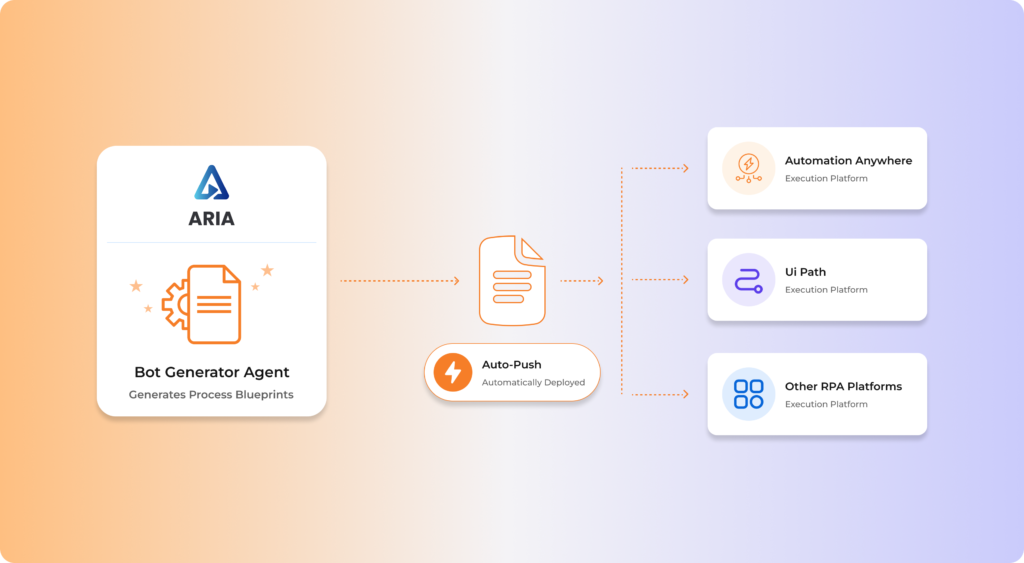
IT automation starts with understanding fast-moving service operations, like ticket handling, access provisioning, environment management, and incident workflows. Walk ARIA through how a ticket gets triaged or how access gets granted. It produces the BRD, test cases, feasibility review, and effort estimate for you, usually within hours. Your teams get the documentation without the overhead, and move from discovery to development faster. ARIA also detects and anonymizes PII by default, keeping employee and user data in recordings protected.

Learn about ARIA →
Stage 2

Deliver with 5D1S

The 5D1S methodology accelerates IT automation delivery with reusable components across ITSM, identity, cloud, infrastructure, and enterprise platforms, supported by a consistent framework for building automation at scale.

Explore the framework →

AURA Logo
Stage 3

Sustain with AURA

IT organizations run automations where one failure can break ticket routing, access provisioning, or service delivery for thousands of users. AURA provides runtime support and dependency intelligence. It continuously monitors bots and the applications, APIs, databases, and infrastructure they depend on. It detects issues early and pinpoints root causes, turning a system outage into one known blast radius instead of dozens of parallel investigations.

Learn about AURA →
USE CASES

Technology use cases

Enterprise IT

Autonomous incident response

Alerts triaged, correlated across systems, known remediations executed, and a complete diagnostic package on anything that does need a person.

Shared services

Ticket triage and routing

Free-text tickets classified, prioritised and routed correctly at intake, rather than after the third reassignment.

Enterprise IT

Joiner, mover, leaver

Access provisioned and deprovisioned across dozens of systems and entities, with compliance evidence produced as a by-product.

Shared services

Multi-entity estate governance

One standard, one dependency graph, one monitoring view, across an estate that grew through acquisition rather than design.

SUCCESS STORIES

Proven results in technology.

Global shared services, 90+ entities

Alert volume triaged by hand across 90+ entities, with no dependency visibility, so every upstream change produced an unpredictable set of silent bot failures and every incident started with an investigation.

Full dependency graph registered under AURA, with an agentic triage layer absorbing alert volume at intake

AURA prevented 412 production incidents in 90 days. Uptime at 99%. MTTR down 71%.

Read full case study →

Tier 2 Aerospace Manufacturer

Quality documentation consuming 35% of engineering team capacity across AS9100 and customer-specific requirements.

Automated quality document generation, routing, and archival with full audit trail and compliance verification.

Engineering time on documentation reduced by 72%. Zero non-conformances in first 18 months post-deployment.

Read full case study →

BUSINESS OUTCOMES

From IT Automation to Faster, More Resilient Operations

From active enterprise deployments across complex IT automation environments.

412

Incidents prevented in 90 days

Dependency-aware monitoring catching the upstream change before it reached the bot, and the bot before it reached the business.

71%

Faster mean time to resolution

Diagnosis replaced by a dependency graph that already knows which system changed and what it broke.

98%

Of issues meeting SLA

Fewer failed runs, fewer reruns, fewer breach events across the monitored estate.

99%

Uptime across the estate

Availability held across 90+ entities without headcount growing in proportion.

SERVICES

Relevant solutions for IT

INSIGHTS

Related reading

View all insights →

Why Automation programs Stall in the First Six Weeks

How Enterprise AI Is Reshaping Business Decision-Making in 2026

FAQ

Common questions about AutomationCOE.

Not finding your answer? Email us directly.

AutomationCOE helps IT teams automate complex workflows across applications, infrastructure, service operations, and enterprise systems. ARIA accelerates process discovery and automation requirements, while AURA provides runtime monitoring, dependency intelligence, and operational assurance for deployed automations.
ARIA analyzes IT process walkthroughs to identify process steps, decisions, business rules, exceptions, and system interactions. It transforms this information into automation-ready documentation, including PDDs, BRDs, test cases, feasibility assessments, and effort estimates, helping IT teams move from discovery to development faster.
AutomationCOE can automate incident-response workflows by correlating alerts across systems, identifying known remediation actions, and executing appropriate remediations automatically. When human intervention is required, the system can provide a diagnostic package to help IT teams resolve incidents faster.
AURA provides runtime assurance for enterprise automation by monitoring bots, applications, APIs, infrastructure, databases, and system dependencies. It helps IT teams detect operational issues, investigate incidents, understand dependencies, and maintain visibility into automation health.
AURA maps dependencies across applications, systems, automations, and entities in real time. When a system or upstream dependency changes, AURA can identify which automations may be affected and predict potential failures, helping IT teams understand the potential blast radius before an incident occurs.
Yes. AutomationCOE is designed for enterprise environments where workflows span multiple applications, APIs, infrastructure, databases, and services. ARIA helps map and structure processes during discovery, while AURA provides visibility into the dependencies and operational health of deployed automations.