Intelligent Automation for
Banking, Financial Services & Insurance
Transform complex BFSI processes with intelligent automation that accelerates process discovery, streamlines operations, and improves automation reliability. AutomationCOE combines AI-powered automation intelligence with runtime assurance through ARIA and AURA to help financial institutions scale automation with greater speed, visibility, and control.
The Problem
Where BFSI automation stalls
The constraint in financial services is rarely the bot. It's the governance around it, which is why buying a better automation tool doesn't fix any of the following.
01
Core banking and channel fragmentation
Core platforms, digital channels, payment rails and CRM don't integrate cleanly, so people do the bridging work at every interface, and nobody has a single view of a customer journey.
02
KYC and onboarding document volume
Identity documents, proof of address and corporate structures turn up in formats that change with every market and counterparty. The result is high-volume manual review sitting on top of automation you already built.
03
Regulatory reporting burden
Reporting obligations across jurisdictions eat compliance capacity, with data assembled by hand from systems that were never designed to talk to each other.
04
Reconciliation across disconnected systems
Daily reconciliation between core, ledger, custodian and counterparty data gets done by people, because the exception rate is too high for rule-based automation to absorb. .
05
Claims and policy administration
Insurance operations run claims, endorsements and renewals across legacy policy systems where every exception exits to a human queue.
06
Audit trails that stop at the bot boundary
Automations log what they did, not why. Eighteen months later a regulator asks, and compliance can't reconstruct the decision.
96%
Reduction in cycle time
6,500+
Bots deployed globally
84%
Straight-through processing rate
INDUSTRY OVERVIEW
Powering Smarter, More Reliable BFSI Operations
Banking, financial services, and insurance organizations manage complex, high-volume processes across legacy systems, digital platforms, and regulatory environments. From KYC and onboarding to lending, claims, payments, and reconciliation, automation is becoming essential to improving efficiency and customer experience.
AutomationCOE helps BFSI organizations scale automation with greater speed and reliability. ARIA accelerates process discovery and automation documentation, while AURA provides runtime monitoring and dependency intelligence to help keep production automations resilient.
Why AutomationCOE
Why AutomationCOE for BFSI
We connect core, channel and counterparty systems through an automation layer that's governed and observable, rather than bolted together.

Discover with ARIA
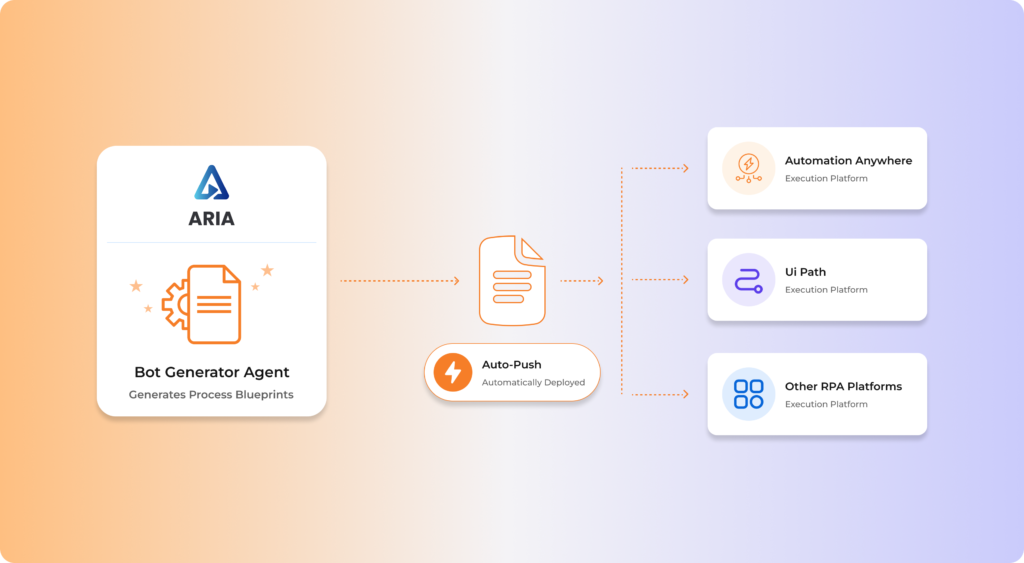
BFSI automation starts with understanding complex processes, requirements, exceptions, and business rules. ARIA analyze process walkthroughs and transform process knowledge into structured, automation-ready documentation. With ARIA you can generate BRDs (Business Requirements Documents), test cases, feasibility assessments, and effort estimates within hours, helping your teams reduce manual documentation and move automation initiatives from discovery to development faster. ARIA also detects and anonymises PII by default, ensuring sensitive customer information captured in banking process recordings is protected from the start.
Learn about ARIA →Deliver with 5D1S
The 5D1S methodology delivers at the pace supervision allows, with reusable components across core and channel systems, and controls, evidence and change governance built in rather than remediated later.
Explore the framework →
Sustain with AURA
BFSI organizations rely on automations across critical systems where a bot failure can disrupt payments, customer operations, loan processing, claims, reconciliation, and other business-critical workflows. AURA provides runtime support and dependency intelligence, continuously monitoring bots and the applications, APIs, databases, and infrastructure they depend on. It helps detect issues early, identify root causes, and provide actionable insights—reducing downtime and helping keep critical BFSI automations running reliably.
Learn about AURA →USE CASES
BFSI use cases
Retail banking
Onboarding and KYC
Identity and address documents extracted, cross-validated and screened at intake, with discrepancies resolved rather than queued for a person.
Commercial banking
Trade finance document review
Letters of credit, invoices and bills of lading checked across market-specific formats, with every extraction traceable to source.
Insurance
Claims and policy administration
Claims, endorsements and renewals processed across legacy policy systems, with exception handling absorbed inside the automation.
All BFSI
Regulatory reporting
Reporting data assembled, reconciled and validated across jurisdictions, with an audit trail behind every figure.
SERVICES
Relevant solutions for BFSI
Proven results in financial services.
Tier-1 retail bank, 14 markets
Loan origination on an 11-day cycle across 14 markets, with document format variance pushing large volumes into manual review despite a fully built bot estate.
ARIA-discovered document automation with an intelligence layer for the format variance, delivered across the existing estate and monitored by AURA.
Cycle time down to 9 hours. Straight-through processing at 84%. No auditor flags.
Global financial services group
Automation fragmented across 4 business units running 6 different RPA tools, no central governance, and quality visibly declining.
A unified COE operating model with one AURA monitoring view across all six platforms. No forced consolidation.
COE established in 90 days. Automation failure rate down 60% within 12 months.
BUSINESS OUTCOMES
Measurable impact in financial services.
From active enterprise deployments across financial institutions.
96%
Reduction in cycle time
Document-heavy origination and administration compressed from days to hours, by removing the manual review exit.
84%
Straight-through processing
Cases that used to need a person now complete end to end, inside defined confidence thresholds.
60%
Lower automation failure rate
Dependency-aware monitoring and one governance model, applied across a fragmented multi-vendor estate.
zero
Auditor flags
Every automated decision carries a reasoning trace, an authority reference and a timestamped record, available on request.
Related reading
Why Automation Programmes Stall in the First Six Weeks