


Before a developer writes a single line of code, most automation requests spend weeks moving through workshops, recordings, write-ups, reviews, and rework. For many Automation CoEs, that pre-development stretch is the real limit on how fast automation can scale. So what would change if weeks of discovery took only a few hours?
That is the problem ARIA was built to solve.
What Is ARIA?
ARIA (Automation Requirements Intelligence Agent) is AutomationCOE’s AI intake agent. It turns a single process recording into automation-ready documentation, including a Process Definition Document (PDD), test cases, feasibility analysis, effort estimates, and PII-safe outputs.
Developed by Tecnoprism, ARIA powers the first three stages of AutomationCOE’s 5D1S lifecycle: Discover, Document, and Define. Instead of relying on manual workshops and analyst write-ups, it uses AI to understand how a process is actually performed and converts that understanding into a package development teams can build from.
Why Is Traditional Process Discovery So Slow?
In a typical program, documenting a single process involves a chain of handoffs:
1. An SME workshop to schedule and interview process owners
2. A recorded walkthrough of the process
3. Manual documentation by a business analyst
4. Review cycles with SMEs and the CoE
5. Rework to fix gaps and misinterpretations
Each handoff adds a queue, each review adds a cycle, and every gap sends the work back. According to AutomationCOE, up to 60% of the effort at this stage goes to documentation and rework rather than automation itself. Quality also varies with the analyst who writes the document, and screenshots in recordings often expose live customer data.
How Does ARIA Work?
ARIA replaces that chain of handoffs with one continuous workflow inside a single workspace.
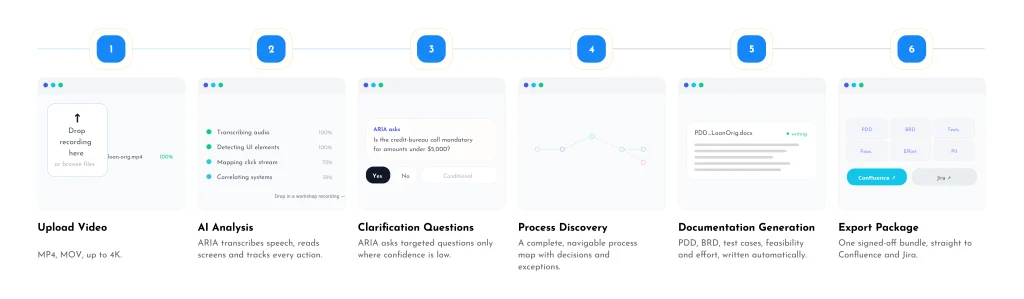
ARIA does more than transcribe a recording. It interprets every click, screen, and spoken word as an observation or inference, and asks targeted questions only where its confidence is low. SMEs spend minutes answering specific questions instead of hours in follow-up meetings, and the final package is ready for sign-off.
What Are ARIA’s Core AI Capabilities?
ARIA runs ten AI capabilities through a single reasoning pipeline, with each capability feeding the next:
| Capability | What it does |
| Video analysis | Parses the user interface frame by frame |
| Speech understanding | Converts narration into intent |
| Process mining | Identifies steps, loops, and branches |
| PDD generation | Produces sign-off-ready documentation |
| Test case creation | Writes positive, negative, and edge-case tests |
| Feasibility analysis | Estimates how much of the process can be automated |
| Complexity scoring | Rates complexity and the factors driving it |
| Effort estimation | Projects person-days and ROI |
| PII detection | Finds names, IDs, and account details |
| PII anonymization | Redacts or tokenizes sensitive data |
How Does ARIA Simplify AI Process Discovery?
It Collapses Weeks Into Hours
A single upload replaces the workshop, write-up, and review sequence. According to AutomationCOE, ARIA makes processes development-ready 92% faster than a manual business analyst process.
It Removes Manual Documentation Work
Business analysts move from writing documents to validating them. Their expertise goes into judgment and sign-off rather than formatting and transcription.
It Delivers Consistent Output Every Time
Every PDD follows the same CoE template, regardless of who recorded the process or which team requested it. Reviews become faster, and handoffs to development become cleaner.
It Surfaces Feasibility and Effort Earlier
Feasibility, complexity, and effort estimates arrive with the documentation, so leaders can prioritize before committing development resources.
It Reduces Review Cycles and Rework
Targeted clarification questions resolve ambiguity during analysis, and outputs are cross-referenced and validated. Fewer gaps reach development, which means less rework later.
It Protects Sensitive Data by Design
ARIA detects and anonymizes PII inline, before any document is generated. Every output is redaction-verified and audit-ready, which makes ARIA suitable for regulated industries such as banking, insurance, and healthcare.
Where Does ARIA Fit in the Automation Lifecycle?
AutomationCOE organizes automation into the 5D1S lifecycle: Discover, Document, Define, Develop, Deploy, and Support. ARIA owns intake, covering Discover, Document, and Define, and hands a sign-off-ready package to development teams building on platforms such as UiPath, Automation Anywhere, Blue Prism, or Microsoft Power Automate.
Once automations go live, AURA, AutomationCOE’s runtime agent, takes over Deploy and Support with dependency-aware monitoring, root cause analysis, and predictive operations. Together, the two agents cover the full lifecycle: ARIA fixes intake, and AURA defends runtime.
What Business Outcomes Can Enterprises Expect?
For executive leaders, ARIA changes the economics of automation intake. AutomationCOE reports the following outcomes compared with a manual business analyst process:
• 92% faster time to development-ready documentation
• Up to 6x more processes documented per quarter with the same team and budget
• 100% consistent documentation built on the same CoE template
• PII-safe outputs, with sensitive data redacted before anyone sees it
The broader impact is a faster automation pipeline, lower total cost of ownership, and better prioritization of where automation investment goes.
Is ARIA Right for Your Automation CoE?
ARIA is designed for enterprises that run automation across multiple processes, systems, and teams, particularly where discovery backlogs slow delivery or where regulated data makes manual documentation risky. If your analysts spend more time writing PDDs than improving processes, or your developers regularly wait on incomplete requirements, ARIA addresses that gap directly.
The simplest way to evaluate it is with your own process. In a 45-minute live session, AutomationCOE runs one of your recordings through ARIA and hands you the generated PDD, test cases, feasibility report, and a PII-safe bundle.
Frequently Asked Questions
What is ARIA?
How does ARIA generate a Process Definition Document?
How is ARIA different from traditional process mining tools?
Does ARIA protect sensitive data?
Which automation platforms does ARIA support?
How long does ARIA take to document a process?

Ready to put these ideas into practice?
See how Automation COE transforms enterprise intelligence into measurable business outcomes.