

ARIA and AURA: How AutomationCOE Connects Process Discovery With Runtime Assurance

In most enterprises, the team that documents a process and the team that keeps the resulting bot running rarely work from the same information. Discovery happens in workshops and documents. Runtime operations happen in dashboards and incident queues. By the time a bot fails in production, the knowledge captured at intake is often buried in a document no one on the support team has read.
What if the work done before development and the work done after deployment were part of the same system? That idea sits at the center of AutomationCOE.
Why Do Process Discovery and Runtime Assurance Need to Be Connected?
Enterprise automation tends to break at two ends. At intake, manual discovery and documentation slow delivery and introduce gaps in requirements. At runtime, automations depend on systems the automation team does not control, so failures surface late and are hard to diagnose.
When these two ends are managed with separate tools and teams, problems compound:
- Context is lost at handoff: the exceptions and dependencies identified during discovery rarely reach the people supporting the bot.
- Runtime lessons never reach intake: recurring failure patterns do not inform how future processes are assessed or prioritized.
- Visibility is fragmented: leaders cannot see one consistent picture of a process from recording to production.
- Total cost of ownership rises: rework at the start and incidents at the end consume capacity that should go toward new automation.
Connecting discovery and runtime assurance closes those gaps.
What Is ARIA?
ARIA (Automation Requirements Intelligence Agent) is AutomationCOE’s AI intake agent. It turns a process recording into a sign-off-ready Process Definition Document (PDD), test cases, feasibility analysis, complexity score, and effort estimate, with PII detected and anonymized before any output is shared.
What Is AURA?
AURA (Automated Uptime & Runtime Assurance) is AutomationCOE’s AI runtime agent. It continuously monitors bots, applications, APIs, databases, and infrastructure, validates readiness before each run, predicts failures, and traces incidents to their root cause.
How Do ARIA and AURA Work Together?
AutomationCOE is a unified platform that connects process discovery and runtime assurance across its 5D1S lifecycle: Discover, Document, Define, Develop, Deploy, and Support. ARIA owns the front of the pipeline, AURA owns the back, and development teams build in between.
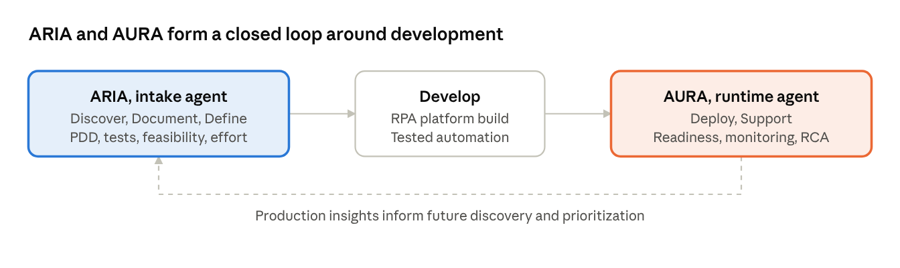
AutomationCOE closed loop · intake to runtime and back
From Recording to Release
The lifecycle begins when a business user records a process. ARIA analyzes the recording, asks targeted clarification questions where its confidence is low, and produces a sign-off-ready package: the PDD, test cases, feasibility analysis, complexity score, and effort estimate. Development teams then build on platforms such as UiPath, Automation Anywhere, Blue Prism, or Microsoft Power Automate, starting from complete, consistent requirements.
From Release to Reliability
At deployment, AURA validates environments, device health, application latency, and database readiness before a bot runs. Once the automation is live, AURA maps its dependencies across applications, services, and infrastructure, monitors every execution in real time, and traces incidents to their root cause with recommended actions for mitigation and recovery.
From Production Back to Discovery
The loop does not end at go-live. Runtime insights, such as which dependencies fail most often and which processes generate recurring incidents, help Automation CoE leaders refine how future candidates are assessed and prioritized. Each new wave of automation benefits from what production has already revealed.
ARIA vs AURA: A Side-by-Side View
| ARIA | AURA | |
| Role | Intake agent | Runtime agent |
| Lifecycle stages | Discover, Document, Define | Deploy, Support |
| Primary input | Process and workshop recordings | Bots, systems, APIs, and dependencies |
| Key outputs | PDD, test cases, feasibility, complexity, effort | Readiness checks, live monitoring, root cause analysis, SLA reporting |
| Core strength | Faster, consistent, PII-safe documentation | Predictive, dependency-aware reliability |
| Reported outcome | 92% faster documentation | 70% fewer incidents, 5x faster RCA |
The reported outcomes are figures published by AutomationCOE.
What Changes When Discovery and Runtime Are Connected?
For Automation CoE leaders, a connected lifecycle delivers benefits that neither agent could provide alone:
- One continuous view of every automation, from the original process recording to its performance in production
- Less rework at the start, because development begins with complete, consistent requirements
- Fewer incidents at the end, because readiness checks and dependency monitoring catch issues before they reach the business
- Better prioritization over time, as production data informs which processes to automate next
- Stronger governance, with standardized, PII-safe documentation and auditable operational records
- Lower total cost of ownership, as less capacity goes to rework and incident response
Who Benefits Most From ARIA and AURA?
The connected approach is designed for enterprises where automation is business-critical and operates across many processes, systems, and teams. It delivers value to:
- CIOs, COOs, and Automation CoE leaders who need faster delivery, predictable SLAs, and measurable ROI
- Business analysts who want to validate documentation rather than write it from scratch
- Automation developers who need complete requirements before they build
- Operations and support teams responsible for keeping bots running
It is especially relevant in regulated sectors such as banking, insurance, healthcare, manufacturing, retail, and IT, where audit readiness and data protection are essential.
Final Thoughts
Process discovery and runtime assurance are often treated as separate disciplines, owned by different teams and supported by different tools. AutomationCOE connects them. ARIA ensures automations are built on accurate requirements, AURA ensures they stay reliable in production, and the insights from each strengthen the other.
The result is an automation program that scales faster, breaks less often, and costs less to run.
Frequently Asked Questions
What is the difference between ARIA and AURA?
Why connect process discovery with runtime assurance?
Which lifecycle stages do ARIA and AURA cover?
Can ARIA and AURA be used separately?
Which RPA platforms does AutomationCOE support?
How does AutomationCOE reduce total cost of ownership?


Ready to put these ideas into practice?
See how Automation COE transforms enterprise intelligence into measurable business outcomes.