

What Is an Automation CoE? A Practical Guide to Building and Scaling Enterprise Automation

Enterprises have invested years building automation programs. They have RPA platforms, governance frameworks, development standards, reusable components, and specialized teams.
Yet many leaders are still asking a difficult question: Why does scaling automation remain so hard?
A promising process can spend weeks moving through discovery and documentation before development even begins. Business analysts still create Process Definition Documents manually. Once automations reach production, teams may only learn about failures after a business process has already been affected.
The challenge is no longer simply getting automation into the enterprise. It is building an operating model capable of discovering, governing, scaling, and sustaining automation across the organization.
That is where the Automation CoE needs to evolve.
What Is an Automation Center of Excellence?
An Automation Center of Excellence, commonly called an Automation CoE, is a centralized enterprise capability that establishes the strategy, governance, standards, technology, and operating practices required to scale automation across an organization.
Traditionally, the Automation CoE has been responsible for identifying automation opportunities, establishing development standards, governing RPA programs, managing reusable assets, maintaining security controls, and measuring automation performance.
This model brought much needed structure to enterprise automation.
But the automation landscape has changed significantly.
RPA bots now operate alongside APIs, artificial intelligence, process intelligence technologies, orchestration platforms, and increasingly autonomous AI agents. As the technology changes, the role of the Automation CoE has to change with it.
Why Did Enterprises Build Automation CoEs?
As RPA adoption expanded, enterprises quickly discovered that automation could not scale effectively through disconnected departmental initiatives.
Without a common operating model, organizations risked duplicating automations, using inconsistent development practices, creating security concerns, and building automation estates that became increasingly difficult to manage.
The Automation CoE gave enterprises a more structured way to govern automation, standardize development, and scale automation across business functions.
It introduced governance, standardized development practices, reusable components, technology controls, and a structured way to evaluate automation opportunities.
Those responsibilities remain important.
However, enterprise leaders today need answers to broader questions.
Are we identifying the right processes to automate? How quickly can an opportunity move from discovery to development? How much effort is being spent documenting processes? Are our automations delivering expected business outcomes? Can we identify operational risks before they interrupt critical workflows?
Answering those questions requires looking beyond bot development.
Where Does the Traditional Automation CoE Model Start to Break?
Many Automation CoEs have become highly efficient at managing development while the stages before and after development remain heavily dependent on manual work.
Consider what happens before a developer starts building an automation.
Subject matter experts explain the process. Workshops are recorded. Business analysts interpret those recordings. Process steps are documented. Process Definition Documents are created. Requirements are reviewed. Missing information creates another round of clarification.
Every handoff introduces time, interpretation, and potential rework.
The same visibility gap can appear after deployment.
An automation may depend on applications, APIs, credentials, infrastructure, databases, or downstream systems. A bot may appear healthy while the larger business process it supports is already experiencing problems.
For a C level executive, this is not merely an automation operations issue. It is a visibility problem across the automation investment.
This is where AutomationCOE, an enterprise automation platform designed and developed by Tecnoprism, brings a broader perspective to the automation lifecycle, connecting process discovery and preparation before development with visibility and intelligence after deployment.
Should an AutomationCOE Stop at Bot Development?
No. A modern AutomationCOE should have visibility across the complete automation lifecycle:
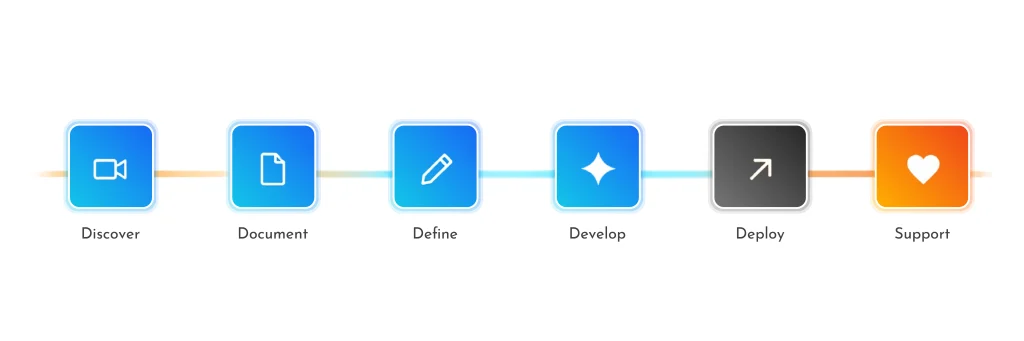
Each stage affects the next.
Incomplete process discovery produces incomplete requirements. Incomplete requirements lead to development rework. Limited production visibility increases incident resolution time. Disconnected tools make it difficult to understand how automation is performing at the portfolio level.
This is why enterprise automation strategy must connect what happens before development with what happens after deployment.
AutomationCOE extends the traditional CoE concept beyond governance and development. It brings discovery, documentation, operational intelligence, and runtime assurance into a more connected enterprise automation model.
The goal is not simply to help enterprises build more automation. It is to help them understand, prepare, operate, and improve automation throughout its lifecycle.
What Does an AI Powered AutomationCOE Look Like?
Artificial intelligence creates an opportunity to rethink several manual activities that automation teams have accepted as unavoidable.
Within AutomationCOE, that shift looks like this:
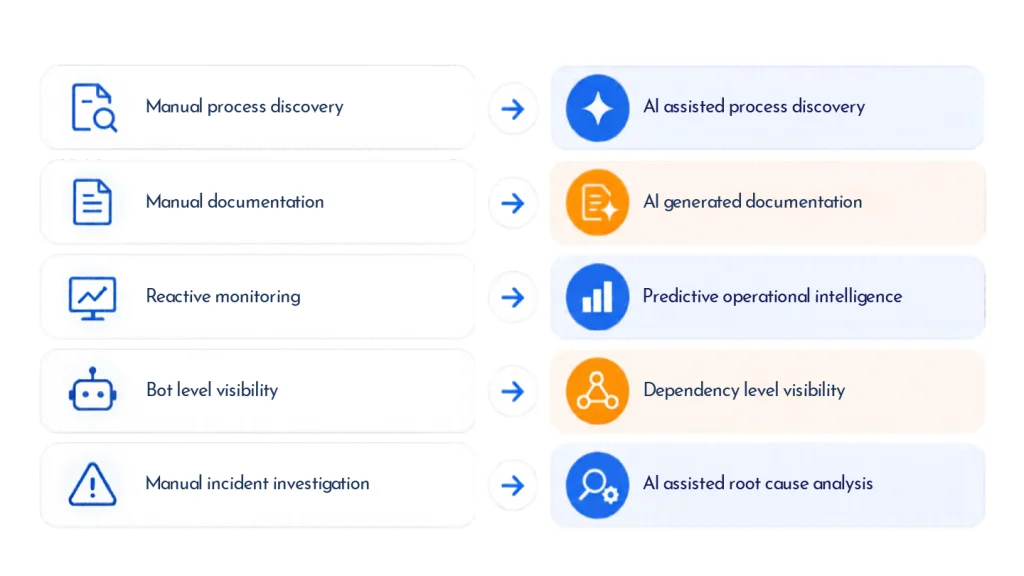
This approach does not remove people from enterprise automation. It changes where their expertise creates the most value.
Instead of spending hours translating process recordings into documentation, experienced analysts can focus on process complexity, business value, exceptions, governance, and automation strategy.
Operations teams can spend less time searching through fragmented systems to understand why an automation failed and more time improving resilience across the automation estate.
For enterprise leaders, the measurement also changes.
The question is no longer simply:
“How many bots did we deploy?”
A more valuable question becomes:
“How effectively are we discovering, operating, and scaling automation across the enterprise?”
AutomationCOE is designed around that broader question.
How Is AutomationCOE Using AI to Transform Process Discovery?
Process discovery has traditionally relied on interviews, workshops, observation, screen recordings, and manual documentation.
The problem is not that these methods cannot capture process knowledge. The problem is the amount of manual interpretation required to convert that knowledge into something development teams can actually use.
AutomationCOE applies AI to shorten that path.
Through ARIA, process recordings can be transformed into structured, automation ready outputs such as Process Definition Documents, test cases, feasibility assessments, effort estimates, and PII protected documentation.
Instead of asking business analysts to manually reconstruct every process from recordings and notes, AI can assist in identifying process steps, decision points, actions, and relevant information.
The objective is not simply faster documentation.
It is creating a shorter and more consistent path from process knowledge to development ready requirements.
For enterprises managing large automation pipelines, this can address one of the most persistent scaling problems: increasing the number of automation opportunities being evaluated and prepared without continuously increasing the manual effort behind discovery.
How Does AutomationCOE Bring Runtime Intelligence to Enterprise Automation?
Getting an automation into production is only part of the lifecycle.
Applications change. APIs become unavailable. Credentials expire. Infrastructure behaves differently. Upstream and downstream dependencies create failures that may not originate inside the automation itself.
Traditional monitoring often focuses on a simple question:
Is the bot running?
AutomationCOE is designed to go further.
Enterprise operations teams need to understand what caused a failure, which dependency is responsible, what business process is affected, whether the incident is isolated, and whether the issue could have been identified earlier.
Through AURA, AutomationCOE brings runtime assurance, dependency monitoring, predictive alerting, operational intelligence, and AI assisted incident analysis into the automation lifecycle.
This changes the conversation from monitoring an individual bot to understanding the environment in which automation operates.
For enterprise leaders, that distinction matters.
A bot showing a healthy status does not necessarily mean the business process is healthy. Runtime intelligence helps provide the broader context required to understand automation performance and operational risk.
Together, ARIA and AURA connect two areas that have traditionally remained separated: understanding an automation before it is built and understanding how it performs after deployment.
What Should AutomationCOE Help Enterprises Measure?
Bot count alone tells executives very little about the health of an automation program.
AutomationCOE should help enterprises move toward measuring both delivery performance and business performance across the automation lifecycle.
Important metrics include:
- Discovery to development time
- Documentation effort
- Automation pipeline velocity
- Automation success rate
- Production incidents
- Mean time to resolution
- Automation availability
- Business process availability
- Automation ROI
- Total cost of ownership
These metrics provide a broader view of whether automation is actually improving enterprise operations.
For example, increasing the number of deployed automations means little if discovery cycles remain slow, production incidents continue to rise, or automation teams spend excessive time resolving failures.
The objective is not to prove that automation exists.
It is to understand whether automation is creating sustainable, measurable value at enterprise scale.
From Traditional Automation CoE to an Intelligent Automation Operating Model
The traditional Automation CoE is not becoming less relevant as AI enters the enterprise. Its responsibilities are becoming broader.
As organizations move from rule based RPA toward intelligent automation, process intelligence, AI agents, and increasingly autonomous workflows, enterprises will need an operating model that connects technology execution with business process knowledge.
This is the direction AutomationCOE is built to support.
By connecting process discovery and documentation through ARIA with runtime intelligence and assurance through AURA, AutomationCOE brings traditionally disconnected parts of the automation lifecycle closer together.
The next generation of enterprise automation will require more than governing bots.
It will require organizations to continuously understand processes, identify opportunities, prepare automation requirements, monitor runtime performance, analyze failures, and turn operational knowledge into ongoing improvement.
That creates an important question for enterprise leaders:
Is your Automation CoE designed only to govern the automations you already have, or are you ready for an approach that helps your enterprise discover, operate, and scale what comes next?
Frequently Asked Questions
What is an Automation CoE?
Why do enterprises need an Automation CoE?
What is the difference between Automation CoE and AutomationCOE?
What is ARIA in AutomationCOE?
What is AURA in AutomationCOE?

 AI & Automation
ARIA and AURA: How AutomationCOE Connects Process Discovery With Runtime Assurance
 Priyanka Shinde·
6 min
 AI & Automation
How AI Can Improve the Entire Automation Lifecycle
Priyanka Shinde·
7 min AI & Automation
How to Assess Automation Feasibility Before Development
Priyanka Shinde·
11 minReady to put these ideas into practice?
See how Automation COE transforms enterprise intelligence into measurable business outcomes.