Operations that
hold through peak

Retail volume arrives in waves, and the manual processes that cope in March fall over in November. We build the automation layer that scales with demand instead of with headcount.

The Problem

Where retail automation stalls

Retail has a distinct pressure profile: volume is seasonal, margins are thin, and the exception rate is high. That combination is exactly what rule-based automation handles worst.

01

Order management across channels

Marketplace, direct and wholesale orders arrive in different formats into different systems, and people reconcile them, because no two channels agree on a schema.

02

Returns and reverse logistics volume

Returns are high volume, exception heavy, and visible to the customer. And they grow fastest exactly when capacity is tightest.

03

Supplier and purchase order processing

Vendor documents turn up in whatever format the vendor prefers, which introduces delay and ties up working capital at scale.

04

Customer service ticket volume

Enquiries about orders, returns and delivery arrive faster than they can be triaged, and response time turns into a brand problem rather than an ops problem.

05

Catalogue and pricing data maintenance

Product data, pricing and availability maintained by hand across channels, where a mistake is live and public within minutes.

06

Peak season capacity planning

Seasonal volume met with seasonal headcount, trained late, at a cost that compounds every year.

6500+

Bots deployed globally

12

Industries served

6.9M+

Hours saved annually

INDUSTRY OVERVIEW

Retail's volume problem is a variance problem

Retail operations aren't hard because the volume is high. They're hard because the volume is high and the variance is high. Every marketplace has its own schema, every vendor has its own invoice format, every return has its own reason.

That's precisely where rule-based automation reaches its limit and hands the work back to a person. Intelligent and agentic automation change the economics, because the exception becomes something the automation reasons through rather than escalates. Which is what lets an operation meet November with the headcount it had in March.

Why AutomationCOE

Why AutomationCOE for Retail & Ecom

We connect channel, ERP and logistics systems through a governed layer that holds when volume spikes.

ARIA Logo
Stage 1

Discover with ARIA

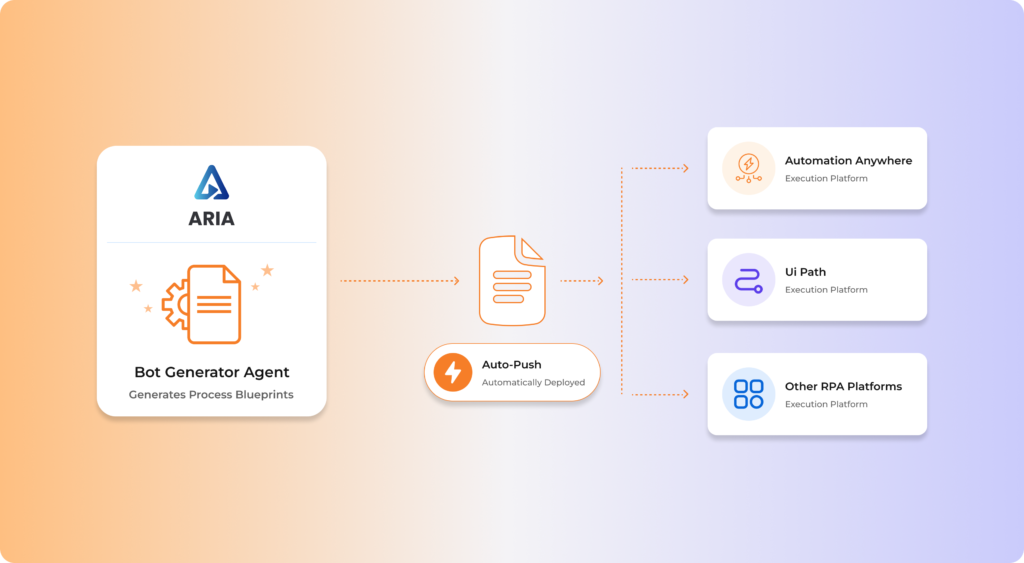
ARIA discovers your operations — order handling, returns, vendor processing, customer service workflows — and generates structured blueprints in hours. Which matters when the automation needs to be live before peak, not after it.

Learn about ARIA
Stage 2

Deliver with 5D1S

The 5D1S methodology delivers at retail pace, with reusable components spanning channel, ERP and logistics systems, and a delivery framework built for seasonal deadlines that don't move.

Explore the framework
AURA Logo
Stage 3

Sustain with AURA

AURA monitors your estate in real time, tracking dependencies across marketplaces and carriers you don't control, and predicting failures before they surface as a customer complaint during your biggest week.

Learn about AURA

USE CASES

Retail & E-commerce use cases

E-commerce

Multi-channel order processing

Orders normalised and reconciled across marketplace, direct and wholesale channels, whatever schema each one insists on.

Retail

Returns and reverse logistics

Returns triaged, validated and dispositioned end to end, with exception cases reasoned through rather than queued.

Retail

Vendor document processing

Purchase orders, invoices and vendor documents extracted and validated across formats, with working capital released as a result.

E-commerce

Customer service triage

Enquiries classified, prioritised and routed at intake, with order status and delivery questions resolved without a person.

SERVICES

Relevant solutions for Retail & E-commerce

SUCCESS STORIES

Proven results in manufacturing.

Global Automotive Supplier

AP processing backlog of 18,000 monthly invoices across 6 plants, with 4.2-day average processing time causing supplier friction.

ARIA-discovered invoice automation across SAP and Oracle environments, with AURA monitoring 180 bots in production.

Average invoice processing reduced to 4 hours. Supplier disputes fell 67%. $2.4M annual savings in year one.

Read full case study

Tier 2 Aerospace Manufacturer

Quality documentation consuming 35% of engineering team capacity across AS9100 and customer-specific requirements.

Automated quality document generation, routing, and archival with full audit trail and compliance verification.

Engineering time on documentation reduced by 72%. Zero non-conformances in first 18 months post-deployment.

Read full case study

BUSINESS OUTCOMES

Measurable impact in manufacturing.

Outcomes from active enterprise deployments across manufacturing organisations.

35%

Reduction in cycle time

Automated procurement and finance processes eliminate the manual bottlenecks that slow operational throughput.

70%

Faster AP processing

Invoice automation reduces average processing time from days to minutes across standard invoice types.

28%

Lower operational costs

Staff redeployed from manual data entry to higher-value operational and engineering functions.

Real-time

Production visibility

AURA-monitored automation delivers continuous OEE and operational data without manual reporting cycles.

INSIGHTS

Related reading

View all insights →

Why Automation Programmes Stall in the First Six Weeks

How Enterprise AI Is Reshaping Business Decision-Making in 2025

FAQ

Common questions about AutomationCOE.

Not finding your answer? Email us directly.

AI and intelligent automation can streamline high-volume retail processes such as order management, returns, vendor document processing, customer service, and product data maintenance. AutomationCOE connects channel, ERP, and logistics systems through a governed automation layer designed to handle seasonal volume and operational variation.
AI automation can normalize and reconcile orders from marketplaces, direct-to-consumer, and wholesale channels, even when each channel uses different data formats or schemas. AutomationCOE helps automate order processing across these channels, reducing manual reconciliation and improving order-handling efficiency.
Yes. AI and automation can triage, validate, and disposition returns based on return information and business rules. AutomationCOE is designed to reason through exception-heavy return workflows instead of simply sending every unusual case to a manual queue, helping retailers manage high return volumes more efficiently.
AutomationCOE can extract and validate information from purchase orders, invoices, and other vendor documents across different formats. This helps retailers reduce manual data entry, accelerate supplier document processing, and improve working-capital efficiency.
AI can classify and prioritize customer enquiries related to orders, returns, and deliveries and route them to the appropriate workflow. Automation COE can also resolve common order-status and delivery questions without human intervention, helping retailers manage customer-service volumes and improve response times.
AutomationCOE is designed to handle seasonal changes in retail volume without requiring equivalent increases in headcount. ARIA discovers and structures retail workflows, 5D1S provides reusable automation components across channel, ERP, and logistics systems, and AURA monitors dependencies in real time to help predict failures before they affect customers during peak periods.