Automation that holds up
in a validated environment
Healthcare and life sciences automate under constraints most sectors never meet: clinical accuracy, patient data protection, GxP validation. We design for those from the start, rather than adapting to them once the automation is already built.
The Problem
Where healthcare automation stalls
In this sector the documentation and the traceability are as much the deliverable as the automation. Standard tooling doesn't account for that, which is where the following come from.
01
EHR and claims system fragmentation
Clinical systems, payer portals and revenue cycle platforms don't integrate, so someone bridges every interface by hand. Usually across sites that each configured their EHR differently.
02
Prior authorisation volume
Authorisation requests get assembled from clinical notes against payer-specific criteria, by people. Care is delayed and clinical capacity goes into paperwork.
03
Claims denial and appeals burden
Denials arrive with reason codes that need clinical documentation to contest. High volume, deadline-bound, almost entirely manual.
04
GxP documentation burden
Validation, change control and submission documentation demand extensive evidence, and producing it consumes scientific and quality capacity.
05
Pharmacovigilance case volume
Adverse event narratives arrive as unstructured text in several languages, needing coding and assessment at a volume that grows faster than headcount ever will.
06
Multi-site operational variance
A network of sites runs the same process six different ways, which makes standardised automation fragile and estate-wide governance genuinely hard.
92%
Reduction in documentation time
6,500+
Bots deployed globally
100%
PII safe
INDUSTRY OVERVIEW
Healthcare's documentation problem is an automation problem
Healthcare and life sciences organisations produce enormous volumes of documentation — clinical, regulatory, administrative — and most of it gets assembled by people whose expertise lies somewhere else entirely. Engineering capacity, clinical capacity and quality capacity all go into producing evidence rather than doing the work the evidence describes.
Intelligent automation changes that maths. Leading networks and pharmaceutical organisations are extracting structure from clinical documentation, absorbing denial and authorisation volume inside the automation, and generating validated documentation in minutes, with the PII protection and audit traceability that regulators and patients both expect.
Why AutomationCOE
Why AutomationCOE for Healthcare & Pharma
We connect clinical, payer and quality systems through an automation layer that's governed and validated, not improvised.

Discover with ARIA
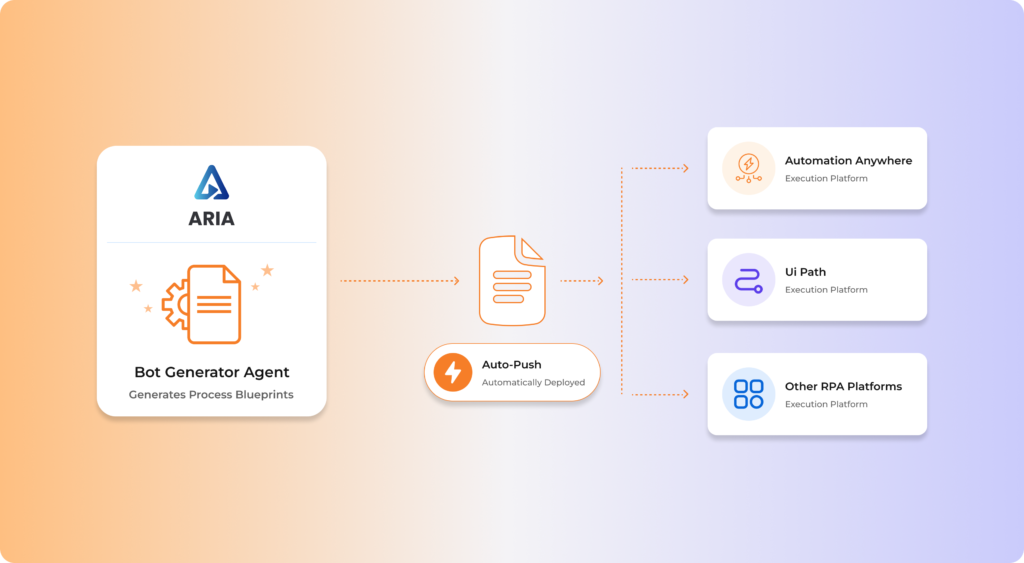
ARIA discovers your clinical and administrative operations — authorisation workflows, claims processing, documentation assembly — and generates structured blueprints with PII detected and anonymised by default. Process recordings in healthcare contain patient data. ARIA is built on that assumption.
Learn about ARIA →Deliver with 5D1S
The 5D1S methodology delivers inside validated environments, with reusable components spanning EHR, payer and quality systems, and validation evidence produced by the process itself rather than reconstructed for the auditor.
Explore the framework →
Sustain with AURA
AURA monitors your estate in real time, tracking dependencies across clinical systems that change without warning, and predicting failures before they touch a care pathway or a submission deadline.
Learn about AURA →USE CASES
Healthcare & Pharma use cases
Healthcare
Claims denial triage
Denial reasons read, supporting clinical documentation retrieved, appeals assembled. Only genuinely clinical judgement gets escalated.
Healthcare
Prior authorisation
Authorisation packages built from clinical documentation against payer-specific criteria, then submitted and tracked without anyone reassembling them.
Pharma
Regulated document assembly
Submission and validation documentation generated and cross-checked inside GxP environments, with every source and edit attributable.
Pharma
Adverse event processing
Case narratives processed and coded across languages, with confidence thresholds calibrated to the cost of a missed signal.
SERVICES
Relevant solutions for Healthcare & Pharma
Proven results in healthcare and life sciences.
Healthcare network, 12 sites
No automation strategy and reactive bot development across 12 sites, an 18% claims denial rate, and no visibility into which automations were contributing to the failures.
ARIA-powered discovery surfaced 280 automation opportunities. The estate was remediated to standard, sequenced into a governed roadmap, and brought under AURA monitoring.
Claims denial rate down to 4.3% within the year.
Top-5 pharma, validated environment
Clinical documentation assembled by hand under GxP constraints, consuming scientific capacity and carrying PII exposure risk at every handoff.
ARIA-generated documentation with PII detection and anonymisation, delivered inside the validated environment with full change control.
Documentation generated in minutes. Time down 92%, GxP aligned, 100% PII safe, 100% audit pass rate.
BUSINESS OUTCOMES
Measurable impact in healthcare and life sciences.
From active enterprise deployments across healthcare networks and pharmaceutical organisations.
92%
Faster documentation
Clinical and regulatory documentation generated in minutes rather than days, giving capacity back to the people who should be doing the science.
76%
Lower claims denial rate
Denial triage and appeal assembly absorbed inside the automation, with clinical judgement escalated rather than the whole case.
100%
PII safe
Patient data detected and anonymised at the point of discovery, not remediated later when someone spots it in a process recording.
100%
Audit pass rate
Documentation, traceability and change control produced by the process, not assembled for the inspection.
Related reading
Why Automation Programmes Stall in the First Six Weeks